

The best Ram truck for your driveway is not necessarily the one with the highest advertised towing number. Your choice should reflect what you actually carry, how often you tow, and whether the truck must also handle commuting, parking, and family trips.
Before comparing Ram truck dealers in CT, write down your loads. Gengras Chrysler Dodge Jeep Ram in East Hartford can help you review individual truck configurations against your trailer and daily driving requirements.
Start With Your Trailer's Loaded Weight
Dry Weight Is Only the Beginning
A trailer's published dry weight may exclude water, propane, batteries, tools, food, and other belongings. Those additions can make the actual travel weight considerably higher than a brochure figure.
If you already own a trailer, use an appropriate public scale to establish its loaded weight. If you are shopping for one, compare its gross vehicle weight rating with your expected equipment and ask the seller about realistic travel weights.
Also identify the hitch type. Conventional trailers transfer tongue weight to the truck, while fifth-wheel and gooseneck setups impose substantial pin or hitch loads in the bed.
Include Everyone and Everything in the Truck
Make a list of passengers, pets, luggage, work materials, bed cargo, accessories, and hitch equipment. Count what you would bring on your heaviest ordinary trip, not just a lightly loaded test drive.
A toolbox or aftermarket accessory reduces the payload available for other items. Planning for the full load helps prevent buying a truck that has adequate trailer-pulling capability but insufficient carrying capacity.
Understand Towing Versus Payload
Towing capacity is the maximum trailer weight a properly equipped configuration may pull under specified conditions. Engine, axle ratio, drivetrain, cab, equipment, and model year all matter.
Payload is the weight occupants and cargo can add to the truck within its limits. Trailer tongue or pin weight uses part of that allowance. Both numbers matter, and the maximum for one configuration cannot be applied to every truck in the same model family.
For example, suppose the tire-and-loading label states that occupants and cargo must not exceed 1,700 pounds. If passengers account for 500 pounds, supplies for 200, and added hitch equipment for 100, the remaining allowance is 900 pounds. Any trailer weight transferred onto the truck must fit within that remainder, along with other additions.
For a travel trailer, calculate tongue weight after loading water and gear. For a fifth-wheel, the bed-mounted pin load can consume available payload faster than buyers expect, even when towing capacity appears sufficient.
That calculation does not replace checking axle ratings, tire limits, receiver ratings, and combined weight restrictions. Ask for the documentation specific to the truck's VIN and equipment.
Compare the Three Ram Truck Families
Ram 1500: Daily Comfort and Conventional Towing
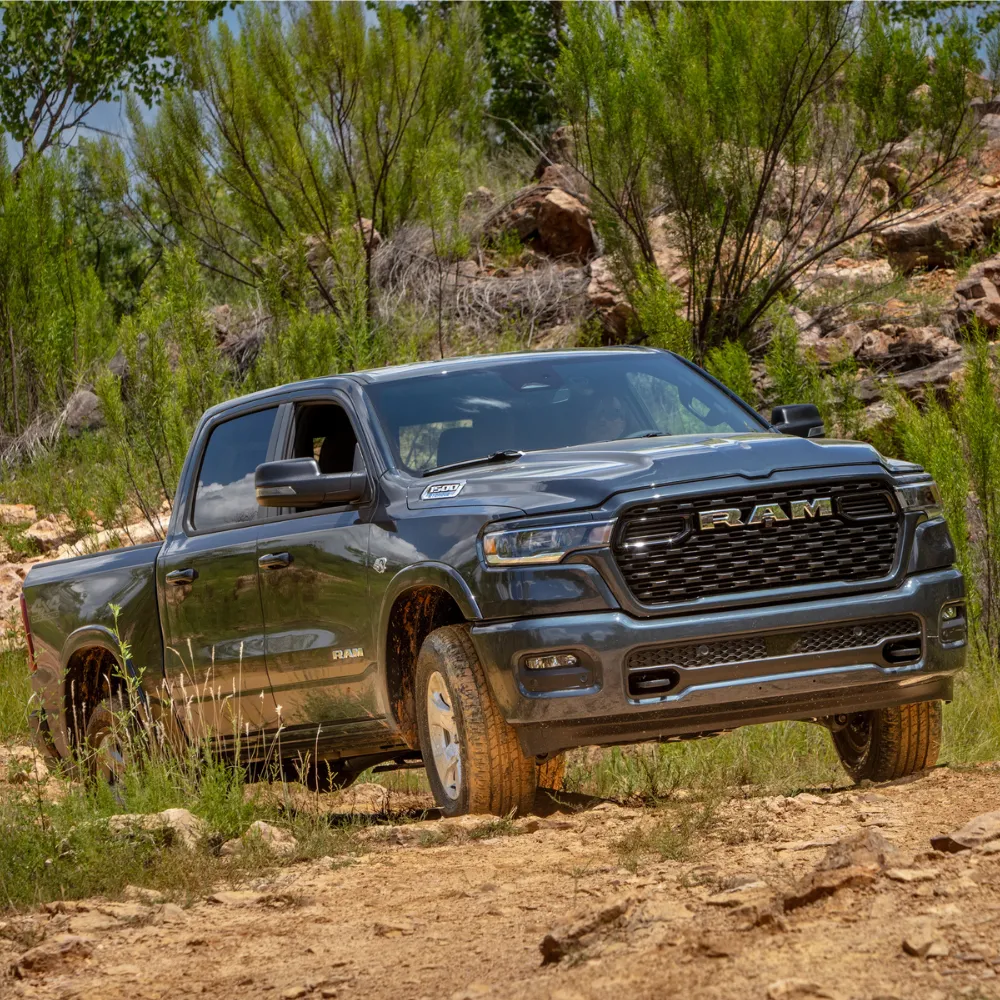
The Ram 1500 is worth examining for commuting, household projects, and conventional trailers that fit its verified ratings. Compare cab comfort, bed dimensions, available towing features, and payload before choosing an engine.
Ram confirms that the 2026 Ram 1500 is not designed or rated for fifth-wheel or gooseneck towing. Do not treat aftermarket hitch modifications as approval to exceed manufacturer limits. For a boat, utility trailer, or travel trailer, verify the particular truck's available capacity first.
Ram 2500: Heavier Workloads
Consider the Ram 2500 when a suitable Ram 1500 does not meet your trailer or cargo requirements. Compare gas and available diesel versions by their actual towing charts rather than assuming one powertrain always wins.
Heavy-duty capability brings trade-offs. Check ride quality when unloaded, bed access, overall height, parking space, fuel costs, and the weight of passengers and equipment. A higher trailer rating does not automatically create unlimited payload.
Ram 3500: Demanding Towing and Hauling
The Ram 3500 deserves consideration for substantial trailers and work-related cargo. Depending on configuration, buyers may compare single- and dual-rear-wheel models, including differences in payload, stability, width, and maneuverability.
For fifth-wheel or gooseneck towing, confirm factory-approved preparation, bed clearance, hitch mounting, and loaded pin weight. A dual-rear-wheel truck might fit a demanding combination, but the correct choice still depends on every applicable rating.
Compare Gas and Diesel Without Guesswork
Diesel powertrains may appeal to owners who regularly tow heavy loads, especially over long distances. Gas configurations can be practical for many workloads and may have different upfront and operating expenses.
Compare the total cost of ownership: purchase price, insurance, fuel, routine service, emissions-system maintenance where applicable, and expected mileage. Engine choice also affects a truck's weight, so compare actual payload labels instead of choosing solely by torque figures.
Evaluate Bed, Cab, and Towing Equipment
Choose a cab that comfortably accommodates passengers, then verify that its configuration still leaves enough payload for cargo and hitch weight. Check bed dimensions for tools, a camper, or the clearance required by your trailer.
Available towing technology may include integrated trailer brake controls, mirrors, cameras, electrical connectors, and hitch-assistance features. Confirm exactly what is installed on the truck you are considering. These features can help with handling and visibility but never increase the manufacturer's weight ratings.
If shopping pre-owned, review used vehicle inventory and ask about modifications, service history, tires, and hitch equipment. A lift kit or larger tires may change fitment and performance without increasing approved capacities.
Verify the Ratings Before Signing
Ask the dealership to identify each applicable number: gross vehicle weight rating (GVWR), gross axle weight ratings (GAWR), gross combined weight rating (GCWR), maximum trailer weight, tire ratings, and hitch limits.
A vehicle can be under its trailer rating but over its rear axle or payload limit. When possible, use scale weights from your actual combination and leave practical capacity for normal changes in passengers or cargo.
For a new purchase, browse available new trucks, record stock numbers and VINs, and confirm availability before visiting. Use the exact manufacturer's information for each candidate rather than an unrelated online maximum.
Bring This Checklist to the Dealership
-
Trailer details: Loaded scale weight, gross trailer rating, tongue or pin load, and hitch type.
-
Truck loads: Passenger weights, tools, bed cargo, and permanently installed accessories.
-
Configuration questions: Engine, axle ratio, drivetrain, cab, bed, hitch compatibility, and relevant equipment.
-
Budget: Insurance, fuel, maintenance, equipment installation, and expected financing costs.
Ask the finance center for an itemized purchase or financing discussion after you identify configurations that safely fit your needs. Avoid letting an appealing monthly payment determine which capacity rating you choose.
Frequently Asked Questions
Is Maximum Towing Capacity Enough to Choose a Truck?
No. Payload, axle ratings, hitch limits, combined vehicle weight, and actual trailer loading all count. Verify every limit for the exact configuration.
Does a More Powerful Engine Always Mean More Payload?
No. Added engine weight, options, and accessories may reduce remaining payload. Check the individual truck's loading label.
Can Airbags Increase My Truck's Ratings?
No. Suspension aids may affect ride behavior, but they do not raise manufacturer-published towing, axle, or gross vehicle weight ratings.
Should I Buy for Future Trailer Needs?
Consider realistic upgrades, but estimate their loaded weights rather than relying on guesses. Choose a configuration that remains within its limits.
Visit Gengras With a Clear Towing Plan
Your search for Ram truck dealers in CT should end with a truck matched to real loads, not advertising claims. Contact Gengras Chrysler Dodge Jeep Ram in East Hartford to compare suitable configurations, discuss inventory, and arrange a test drive before deciding.
Categories:
Ram Trucks, Features, Ram, Ram 3500, Ram 2500, Ram 1500, New Inventory, Pre-Owned Inventory, Service, Parts
